
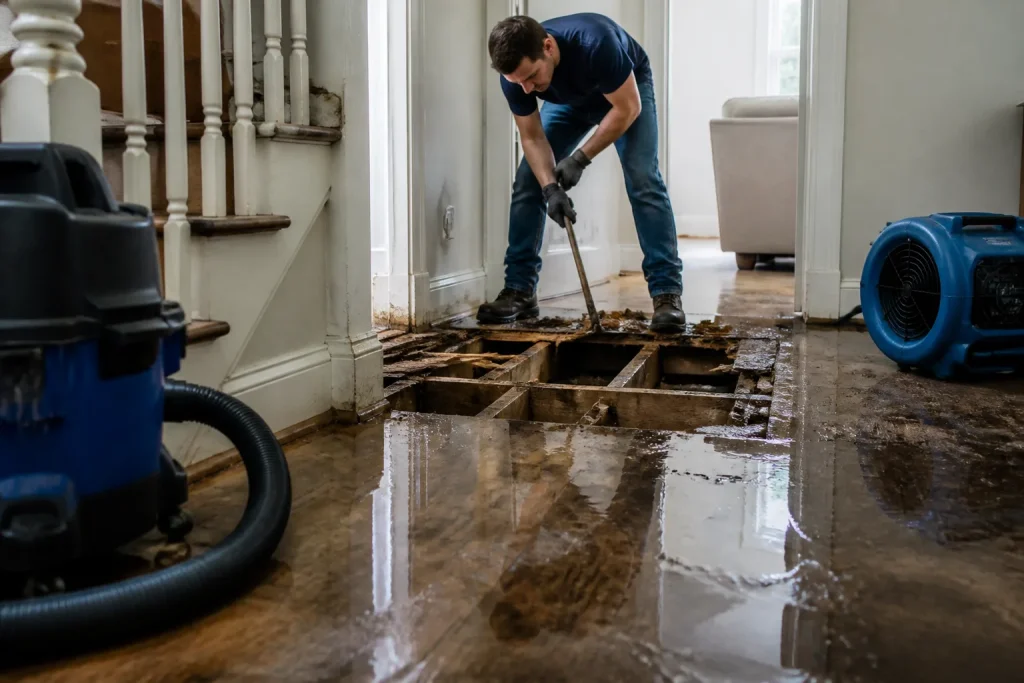
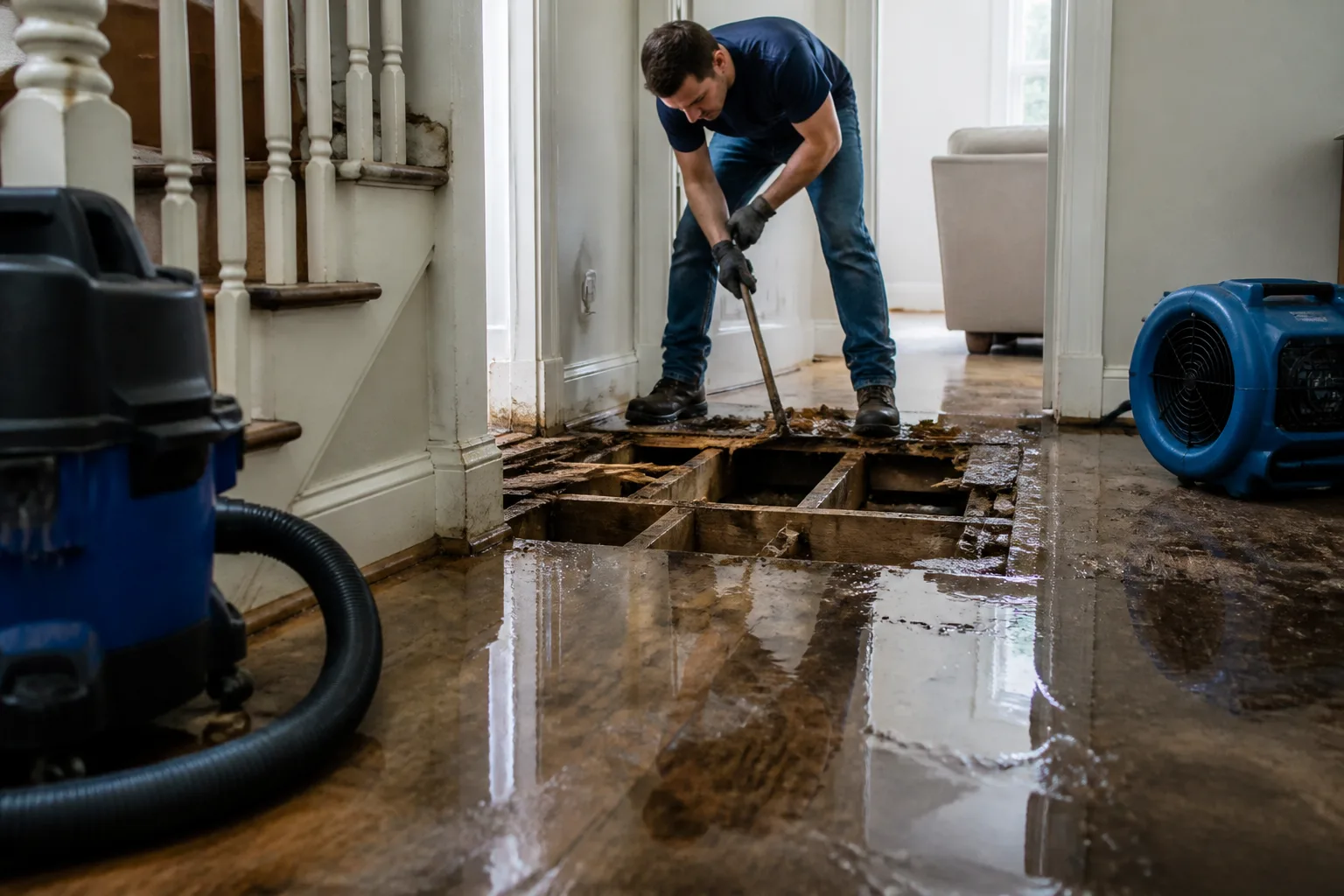
Emergency Water Damage Restoration Near Me: What White Plains Homeowners Should Do First
Water is spreading through your White Plains home right now, and every minute you spend deciding what to do is costing you real money and real damage. The first step is to stop the water at its source if you can do so safely, then document everything with timestamped photos before anything is moved, then call a restoration company that answers with a live person, not a recording. If you’d rather not navigate this alone, call Floodline Restoration Co. at (914) 359-3773 and a live dispatcher will pick up, day or night.
Mold colonization begins within 24 to 48 hours, but the decisions that determine whether your insurance claim pays in full, or gets disputed, are made in the first hour and a half, before any restoration crew arrives. Most “what to do first” guides skip the steps that actually matter to adjusters. This one doesn’t.
Key Takeaways
- The first 90 minutes are when your actions matter most to both structural outcomes and insurance claims
- Document everything with timestamped photos before you move a single item
- Call a restoration company with live dispatch before you call your insurance carrier
- Never use residential fans or a wet-vac on anything but clean water from a supply line
- Ask one specific question to tell a real 24-hour crew from an answering service
The First 15 Minutes: Stop the Water at the Source
In White Plains, where homes range from prewar colonials to newer co-op buildings, the shut-off point isn’t always obvious. In a single-family house, your main water shut-off is typically in the basement near where the municipal line enters the foundation, often under a stairwell or behind the furnace. In a co-op or condo, you may not have a main shut-off at all, because the riser lines are shared, and the valve lives in a locked mechanical room controlled by the building super. Knowing this before an emergency saves you from standing in rising water paging through a phone directory.
For a supply-line leak under a sink or behind a toilet, the angle stop, that small oval valve on the wall, is your fastest stop. Turn it clockwise until it seats. For a burst pipe or a failed water heater, go straight to the main. If you can’t find it or can’t reach it safely, call the White Plains Department of Public Works or your building management, then call us. We’ve cut off supply lines in homes all over Battle Hill, Gedney, and Highlands where the valve was buried behind forty years of stored boxes.
What “source stop” really means: the clock on your insurance claim starts when the water stops flowing, not when you notice it. Adjusters care about how quickly the source was addressed because it shows mitigation effort. A homeowner who stops the flow in ten minutes and documents it is in a far stronger position than one who waited an hour for a callback.
The Documentation Sequence Adjusters Actually Want
Before you move anything, before you drag out towels, before you unplug a single appliance, take photographs. Your phone has a timestamp. Turn on location tagging. This is the evidence package that determines whether your claim settles cleanly or gets nickel-and-dimed.
Photograph the water source, whether that’s a burst washing-machine hose, a failed supply line, or a backed-up floor drain. Then photograph the affected materials: the baseboards, the drywall, the flooring, the underside of the carpet if you can lift a corner. Then photograph the visible tide line, the dark water mark that shows exactly how high the water reached. That line is called the floodline, and it’s where every serious restoration begins.
Then photograph the room from multiple angles. Wide shots show the full extent. Close-ups show material saturation. What you’re building is a time-stamped record that no adjuster can reasonably dispute. We’ve walked onto jobs where homeowners moved furniture to the center of the room and started vacuuming before taking a single photo, and that’s exactly when coverage disputes begin. The carrier wants to see the loss as it happened, not as it looked after cleanup began.
If your phone has a voice memo app, start one and narrate what you see as you photograph. “It’s 9:14 p.m., water is coming from the supply line under the kitchen sink, it’s pooled about a quarter inch across the kitchen floor and flowing toward the dining room.” That narration, tied to the timestamps on your photos, is the kind of documentation adjusters respect and the kind that makes a claim move faster.
Why Calling Your Insurance Carrier First Is the Wrong Order
This is the one step that surprises most White Plains homeowners, because every piece of conventional advice says “call your insurance company immediately.” Here’s the problem: what you tell the carrier in that first call shapes your claim file before any restoration professional has documented the damage. You might describe the water as “just a little overflow” when it’s actually Category 2 water from a dishwasher discharge that’s been sitting in the wall cavity for three days. You might say “I put down some towels” when the real story is that you attempted extraction with a Shop-Vac and cross-contaminated three rooms.
The better sequence: stop the source, photograph everything, call a restoration company with live 24-hour dispatch, and let that company’s certified technicians assess and document the category of water, the extent of saturation, and the drying plan in writing. Then call your carrier. By that point, you have a professional moisture map and photo log, which means your claim is supported by evidence instead of a panicked phone call. We bill the carrier directly and coordinate with adjusters, so you’re never playing messenger between two parties who speak different languages.
One more thing on insurance: if the water came from a broken supply line, a failed appliance, or a water heater, your policy likely covers water damage restoration and the resulting build-back. If it came from a sewer backup, you may need a specific endorsement. If it came from groundwater flooding, that’s flood insurance, which is a separate policy entirely. Knowing the source before you call the carrier changes the entire conversation.
The Single Question That Separates a Real 24-Hour Crew From an Answering Service
Every restoration company in Westchester advertises “24/7 emergency response.” Very few actually provide it. Here’s the test: when you call, ask this exact question: “Will I get a call back, or is there a live dispatcher on the line right now who can put a crew on the road?”
If the answer is a recording that promises a callback within the hour, you’re talking to an answering service. The clock is still running. Water is still migrating through the wall cavities, wicking up the drywall, and finding its way into floor joists. An answering service might get you a crew in three hours, or six, or the next morning. Every hour of standing water expands the affected area and shortens the window before mold colonization begins.
When you call Floodline Restoration Co. at (914) 359-3773, a live dispatcher answers. Not a menu tree. Not a voicemail. A person who knows our White Plains service area and can route a certified crew to your address while you’re still on the phone. We run a dispatch board, not a sales desk. That’s how we’ve operated since Curt Bowman founded the company in 2010, and it’s why the folks who call us at 2 a.m. get a crew at their door the same night, not a promise of one tomorrow.
What Not to Do: The Mistakes That Void Warranties and Complicate Claims
There is a natural instinct to start “helping” the moment water invades your home. Some of that helping makes things worse. Here are the specific actions to avoid during the first 90 minutes, and the reasons why each one hurts you.
Do not run residential fans or your home’s HVAC fan. This is the most common mistake we see in White Plains homes, and it’s a bad one. Household box fans and central air handlers spread moisture-laden air into dry rooms, behind baseboards, and into wall cavities where it condenses and creates secondary damage. They also disturb settled dust and debris, cross-contaminating clean areas. Professional drying uses Dri-Eaz and Phoenix air movers and desiccant dehumidifiers, placed according to a moisture map, not pointed randomly at a wet floor. Running your own fan before we arrive can push water deeper into the structure and can complicate the moisture readings we need to establish the drying baseline.
Do not use a wet-vac on anything but clean water from a supply line. A Shop-Vac is fine for a sink overflow of clean tap water. It is not fine for water from a dishwasher, washing machine, toilet overflow, or any source that qualifies as Category 2 or Category 3 water. That water contains bacteria, detergents, or sewage, and vacuuming it aerates the contaminants and coats the inside of the vac, which then cross-contaminates anything else you use it on for the next year. We’ve seen homeowners in the Battle Hill neighborhood turn a contained washing-machine leak into a whole-house contamination event with one enthusiastic hour of wet-vaccing.
Do not remove soaked carpet, padding, drywall, or baseboards yourself. This one is counterintuitive. It feels like you’re helping. But the moisture log that a restoration company keeps for your insurance carrier depends on establishing measurements of how wet the materials were before extraction and drying began. When you rip out soaked materials and pile them on the curb, you’ve destroyed the evidence the adjuster needs to justify the full scope of the claim. You may also be exposing yourself to mold spores or sewage bacteria without proper PPE. Let the certified crew document, then remove. We’re trained to IICRC, RIA, and IFA standards, and our technicians are background-checked and uniformed. We know what to pull and what to save, and we document every step with photos and moisture readings your adjuster will accept.
And this is the moment to flag something serious: standing water near electrical outlets, appliances, or extension cords is genuinely dangerous. If the water has reached any outlet, appliance plug, or your breaker panel, do not wade into it. Shut off power at the main breaker only if you can reach it without stepping into water. Otherwise, call us from a dry room and wait for the pros. We’ll kill the power, assess the situation, and keep you informed the whole way through. Your safety comes before any item in the house.
What the First Professional Hours Should Look Like
When our crew arrives, the first hour on site follows a sequence that never changes. We locate and confirm the source is stopped. We run a full moisture assessment across the affected area, using meters to map the extent of saturation in floors, walls, and ceilings. We categorize the water according to the IICRC S500 standard: Category 1 from a clean source, Category 2 with significant contamination, or Category 3 with sewage or standing water that’s been sitting long enough to harbor pathogens. We then set up the extraction and drying plan and review it with you, in writing, before we pull the first gallon of water out of your home.
Most jobs are completed in a single visit. We use professional-grade Dri-Eaz, Phoenix, XPOWER, B-Air, and Injectidry equipment, the same gear we’d want in our own homes, because it’s the difference between drying a house and just making it look dry. We take daily moisture readings and keep a running log that we hand to you and your carrier, because a moisture log is the difference between a dry standard that’s been met and one that’s just been claimed. “Dry enough” isn’t a standard. The moisture log is.
If the rebuild requires drywall, trim, flooring, or paint, the same crew that handled the extraction handles the reconstruction. That’s the part that matters to anyone who’s ever been handed off mid-job: there is no inherited crew. The people who read the moisture map on day one are the people who rebuild the space on day ten. We don’t split the job into pieces and leave you chasing two contractors and an adjuster.
When to call a pro: If the water has been standing for more than a few hours, if it came from anything other than a clean supply line, if it has reached your walls or floors in more than one room, or if you have any uncertainty about electrical safety, call us. The cost of a professional restoration is a rounding error compared to the cost of mold remediation down the road. If you’re in White Plains and want to know more, our main Floodline Restoration Co. home page has details on all of it. Looking ahead, if water has been sitting for more than 48 hours, you may be dealing with mold, not just water. Here’s a quick word on that: the organisms that start colonizing within 24 to 48 hours don’t care about your schedule. If you missed that window, Mold Remediation in White Plains is a separate process that requires its own containment and clearance testing. And if the water came from a fire-suppression event rather than a plumbing failure, the game changes in ways most people don’t expect, so it’s worth knowing what Fire & Smoke Damage Restoration in White Plains involves before you assume it’s the same as a standard water loss.
Related services in White Plains: If you’re reading this because you just found water where it shouldn’t be, the full picture of what we do starts with Water Damage Restoration in White Plains. That page covers the complete sequence, from the first moisture reading to the final coat of paint, in the plain language we’d use at your kitchen table.
The 90-Day Done Right Promise, in Plain Words
We stand behind the work. Not with a vague “satisfaction guarantee” that means nothing, but with a written promise that says: if it’s not done right, we make it right. No arguing. No paperwork battles. That’s the 90-Day Done Right Promise, and our crew calls it the Keystone Standard because it’s the stone that holds the arch together. The K.E.Y.S. values behind it, Krafted right, Every time, Your home first, Standing behind it, are posted in our shop and repeated on our jobs. It means the white paint didn’t yellow, the trim didn’t warp, the dehumidifier didn’t come out before the moisture log said it was right to. We’ve been doing this since 2010, and a company that plans to be in White Plains in thirty years doesn’t cut corners in year one. That’s also why we offer a square deal on pricing: no surprises on the bill, and direct insurance billing so you’re not fronting cash while your carrier decides what’s covered. Current offers: $50 off any repair over $250, an $89 seasonal tune-up, and a 5% senior and veteran discount, always. Just ask when you call.
The Bottom Line
Water in your White Plains home is a race against time, and the first 90 minutes determine how that race ends. Stop the source if you can do it safely. Document everything with timestamped photos and a narrated voice memo before you move anything. Call a restoration company with live 24-hour dispatch before you call your insurance carrier. And under no circumstances run residential fans, wet-vac anything that isn’t clean supply water, or rip out soaked materials before a certified crew has documented the loss. If you’re in White Plains and need help right now, Floodline Restoration Co. answers the phone with a live dispatcher, day or night. Estimates are free, and the person on the other end of the line knows exactly what to do next. Call (914) 359-3773.
Frequently Asked Questions
How fast can someone actually get to my White Plains home? When you call Floodline Restoration Co. at (914) 359-3773, a live dispatcher answers and routes a crew to your address immediately. In most White Plains neighborhoods, we reach the job within the hour, and extraction is running during that same first visit. You’re not waiting for a callback.
Will my insurance cover water damage restoration? Most White Plains homeowners’ policies cover sudden and accidental water damage from supply lines, appliance failures, and water heaters, but coverage depends on the source and your specific policy. Sewer backups may require a separate endorsement, and groundwater flooding is covered only by flood insurance. We bill the carrier directly and coordinate with your adjuster, so you don’t have to decide what’s covered on your own.
Do I really need professional drying, or can I just run fans and open windows? Professional drying is not optional for any water loss that has reached walls, floors, or more than one room. Residential fans and open windows push moisture into hidden cavities where it condenses and feeds mold. Our Dri-Eaz, Phoenix, XPOWER, B-Air, and Injectidry equipment, placed according to a moisture map and monitored daily, hits the dry standard that keeps your home safe and your claim defensible.
What if the water has been sitting for more than 24 hours? If water has been present for 24 to 48 hours or longer, assume mold colonization has begun and treat the job as both water damage and potential mold contamination. Call us immediately. We’ll assess the category of water, check for visible growth, and recommend whether mold remediation is needed alongside the water restoration. Call (914) 359-3773 for an honest assessment, not a scare tactic.
Written by Curt Bowman, Owner at Floodline Restoration Co., serving White Plains since 2010.
Need Damage Restoration Help?
Call Floodline Restoration Co. - licensed & insured, here with fast after-hours help in White Plains.
(914) 359-3773